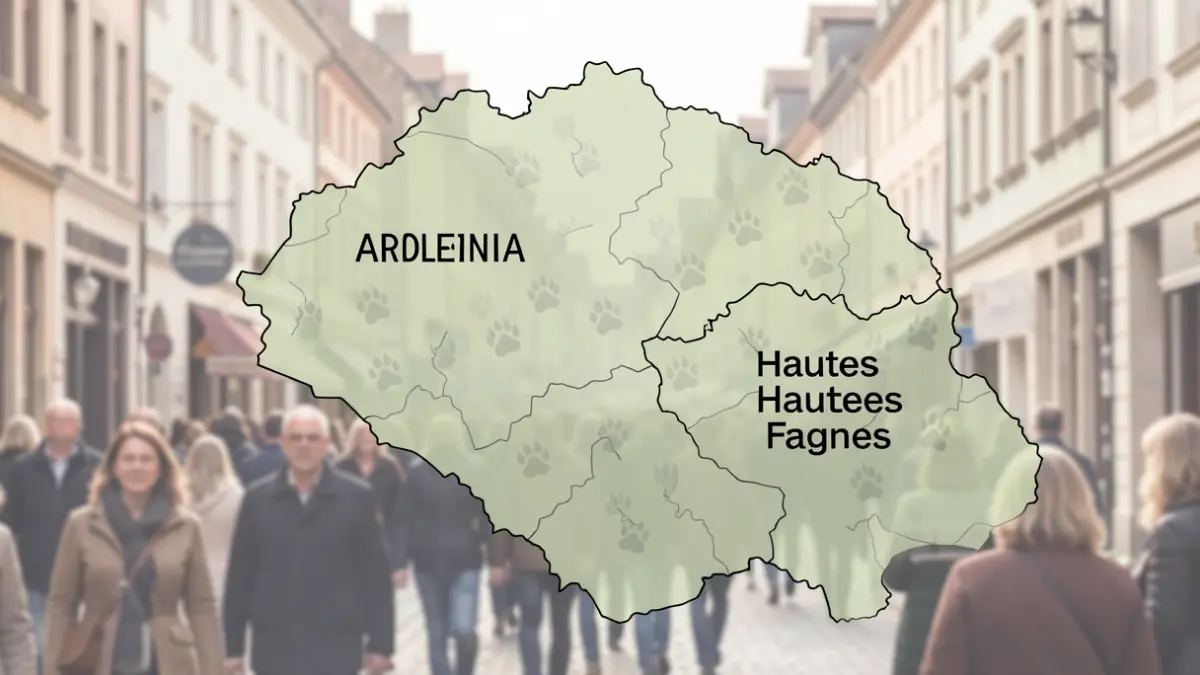
Following the evolution of wolf territories in Wallonia, two Permanent Presence Zones (ZPP) have been adapted. These are the zones of the Saint-Hubert massif and the Hautes-Fagnes. These new boundaries can be consulted on the Wallonia Geoportal and on the biodiversite.wallonie.be website.
Being part of a ZPP allows breeders to benefit from preventive protection measures, even before damage occurs. Priority will be given to sheep and goat farms, which are most vulnerable to wolf attacks.
As a reminder, the Saint-Hubert ZPP, initially created on December 22, 2025, and covering 25,700 ha, was expanded in September 2026. Following new presence indicators detected outside its initial limits, it now covers 36,719 ha. It concerns, in whole or in part, the communes of La Roche-en-Ardenne, Libramont-Chevigny, Marche-en-Famenne, Nassogne, Rendeux, Sainte-Ode, Saint-Hubert, Tellin, and Tenneville.
The Hautes-Fagnes ZPP, defined in October 2020, has also undergone several expansions. Initially 43,000 ha, it now covers 70,064 ha following presence indicators detected in its northwestern periphery in September 2026. It now extends over the communes of Baelen, Büllingen, Bütgenbach, Dison, Eupen, Herve, Jalhay, Limbourg, Malmédy, Raeren, Spa, Stavelot, Theux, Thimister-Clermont, Verviers, Waimes, and Welkenraedt.
Affected breeders can obtain more information via reseauloup.be or by email at prevention.loup@natagriwal.be.